what does Justice tarot card mean

What Does the Justice Tarot Card Mean?

The Justice tarot card is one of the most powerful and thought-provoking cards in the tarot deck. It represents truth, fairness, responsibility, and moral clarity. When Justice appears in a tarot reading, it often signals a moment of accountability — a time when actions, decisions, and intentions are weighed carefully.

Understanding what the Justice tarot card means requires looking beyond simple ideas of right and wrong. Justice speaks about balance, cause and effect, honesty with oneself, and the consequences of past choices.

Overview of the Justice Tarot Card

Justice is a Major Arcana card, which means it deals with significant life themes rather than everyday events. It is commonly numbered XI (11) in most modern decks, though in some traditional systems it appears as VIII (8).

Key Concepts of the Justice Card

  • Truth and honesty
  • Fairness and balance
  • Accountability and responsibility
  • Ethical decision-making
  • Cause and effect

Justice reminds us that life is rarely random — outcomes are often connected to past actions.

Symbolism of the Justice Tarot Card

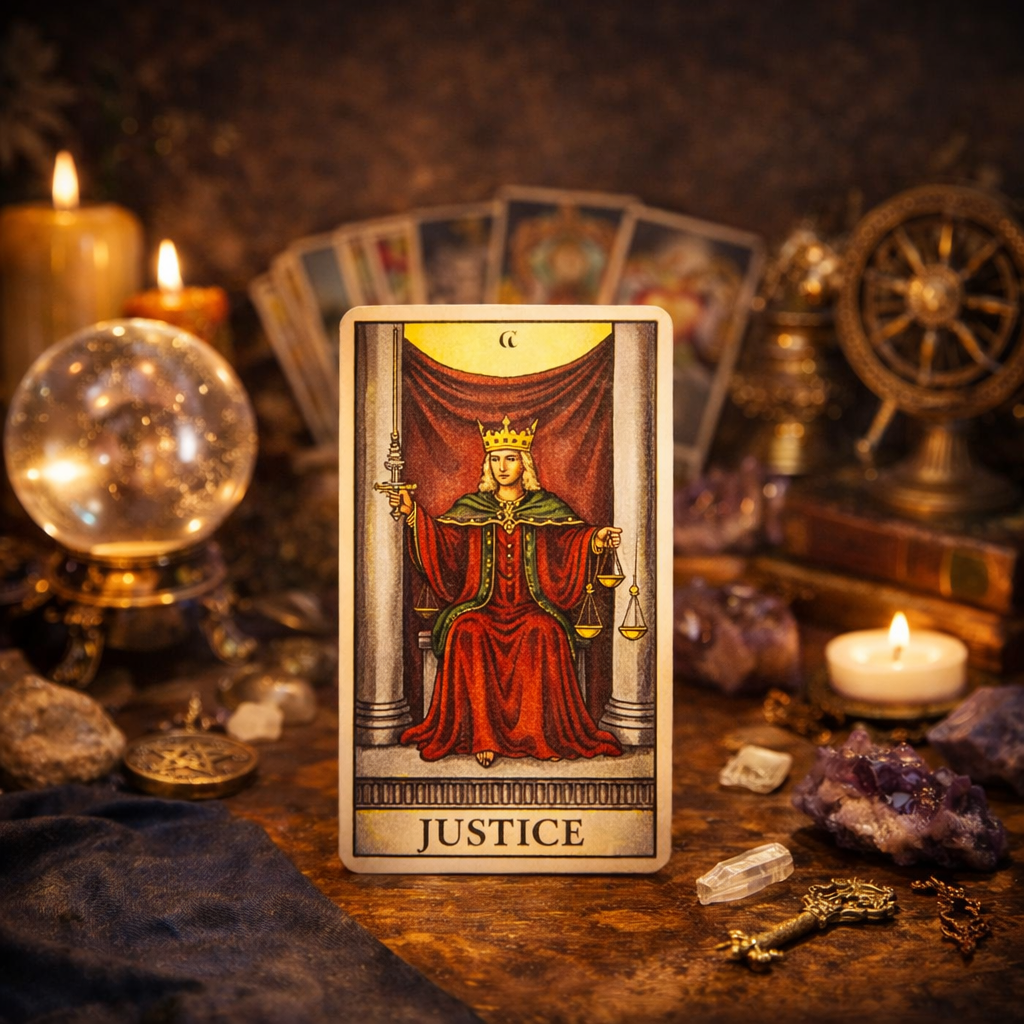
The imagery of the Justice tarot card is highly symbolic, and every detail contributes to its meaning.

Common Visual Elements

SymbolMeaning
ScalesBalance, fairness, weighing facts
SwordTruth, clarity, decisive judgment
CrownAuthority, moral responsibility
Seated postureStability and objectivity
Straight gazeHonesty and directness

The Justice figure is usually calm and composed, showing that truth does not require force — only clarity.

Upright Justice Tarot Card Meaning

When the Justice tarot card appears upright, it represents fairness, truth, and ethical alignment.

General Upright Meaning

  • A situation will be resolved fairly
  • Truth will come to light
  • Honesty is required
  • Actions will have consequences

Justice encourages you to act with integrity and take responsibility for your decisions.

Justice Tarot Card in Love Readings

In love and relationships, Justice focuses on honesty, balance, and equality.

Possible meanings:

  • Fair communication between partners
  • Evaluating whether a relationship is balanced
  • Truth being revealed
  • Legal matters such as marriage or divorce

Justice may ask whether both partners are giving and receiving equally.

Justice Tarot Card in Career and Money

In career or financial readings, Justice is strongly connected to contracts, legal matters, and ethical choices.

Common interpretations:

  • Signing agreements or contracts
  • Fair treatment at work
  • Legal or administrative decisions
  • Being rewarded (or corrected) based on past effort

Justice reminds you that professionalism and integrity matter.

Justice Tarot Card in Personal Growth

On a personal level, Justice asks for self-honesty.

  • Are your actions aligned with your values?
  • Are you avoiding responsibility?
  • Are you judging yourself or others unfairly?

Justice supports growth through awareness and accountability.

Reversed Justice Tarot Card Meaning

When the Justice tarot card appears reversed, its energy becomes blocked, delayed, or internalized.

Common Reversed Meanings

ThemeInterpretation
DishonestyAvoiding the truth
ImbalanceUnfair treatment
DenialRefusing accountability
Legal issuesDelays or injustice

Reversed Justice often points inward, highlighting internal conflict or self-deception.

Reversed Justice in Love Readings

In relationships, reversed Justice may indicate:

  • Lack of honesty
  • Unequal power dynamics
  • Avoiding difficult conversations
  • Feeling judged or misunderstood

It can be a call to restore fairness or address hidden truths.

Reversed Justice in Career and Finances

In work-related readings, reversed Justice may suggest:

  • Unfair workplace dynamics
  • Contract misunderstandings
  • Ethical dilemmas
  • Delayed legal or financial outcomes

It advises caution and thorough review of agreements.

Justice Tarot Card as Advice

When Justice appears as advice, it delivers a clear message:

Act with integrity. Be honest. Take responsibility.

Justice encourages:

  • Objective decision-making
  • Fair treatment of others
  • Transparency in communication

This card advises against emotional bias and encourages rational evaluation.

Justice Tarot Card as Outcome

As an outcome card, Justice suggests:

  • A fair resolution
  • Legal or official decisions
  • Truth being acknowledged
  • Balance being restored

It often indicates that things will unfold according to fairness — even if the process feels uncomfortable.

Justice Tarot Card and Karma

Justice is closely associated with the concept of karma, not as punishment, but as natural consequence.

  • Positive actions lead to positive outcomes
  • Dishonest behavior eventually surfaces
  • Accountability brings clarity

Justice does not judge emotionally — it simply reflects reality.

Justice Tarot Card Keywords Summary

PositionKeywords
UprightTruth, fairness, responsibility, balance
ReversedDishonesty, imbalance, denial, unfairness
AdviceBe honest, act ethically
OutcomeFair resolution, truth revealed

Common Misconceptions About the Justice Card

MythReality
Justice means punishmentIt means balance and truth
Justice is always legalIt’s often moral or emotional
Justice is coldIt is fair, not heartless

Justice is not about blame — it is about understanding cause and effect.

Conclusion

So, what does the Justice tarot card mean?
It represents truth, fairness, accountability, and ethical clarity. Justice reminds us that our choices matter and that balance is restored when we act with integrity.

Whether appearing upright or reversed, the Justice tarot card invites honest reflection and responsible action. It is not a card to fear, but one that encourages growth through truth and balance.
are tarot cards evil?

Are Tarot Cards Evil?

The question “Are tarot cards evil?” has been asked for centuries. Tarot cards are often misunderstood and surrounded by fear, religious concerns, and cultural myths. For some people, tarot is seen as a spiritual tool for self-reflection, while for others it raises worries about superstition, dark forces, or moral danger.

To answer this question honestly, it is important to separate myths from facts, understand the history of tarot, and explore how tarot cards are actually used today.

Where Does the Idea That Tarot Cards Are Evil Come From?

The belief that tarot cards are evil does not originate from tarot itself. Instead, it comes from a mix of religious interpretationshistorical misunderstandings, and popular culture.

Key Sources of This Belief

  • Religious teachings that discourage divination
  • Fear of the unknown or symbolic systems
  • Association of tarot with occult practices
  • Movies and media portraying tarot as dangerous

In many cases, tarot cards became labeled as “evil” simply because they were misunderstood.

The Historical Origins of Tarot Cards

Tarot cards were originally created in Europe during the 15th century as playing cards, not spiritual tools. They were used for games and social entertainment among the nobility.

Only centuries later did tarot begin to be associated with mysticism and symbolism. Even then, tarot was never intended as a method to summon spirits or dark forces.

Tarot History Overview

PeriodUse of Tarot
15th centuryPlaying cards
18th centurySymbolic and philosophical study
19th–20th centurySpiritual and psychological exploration
Modern eraSelf-reflection and guidance

Nothing in the historical development of tarot suggests that tarot cards were created for evil purposes.

What Tarot Cards Actually Represent

Tarot cards are a symbolic language. Each card represents human experiences such as change, growth, fear, love, conflict, and hope.

For example:

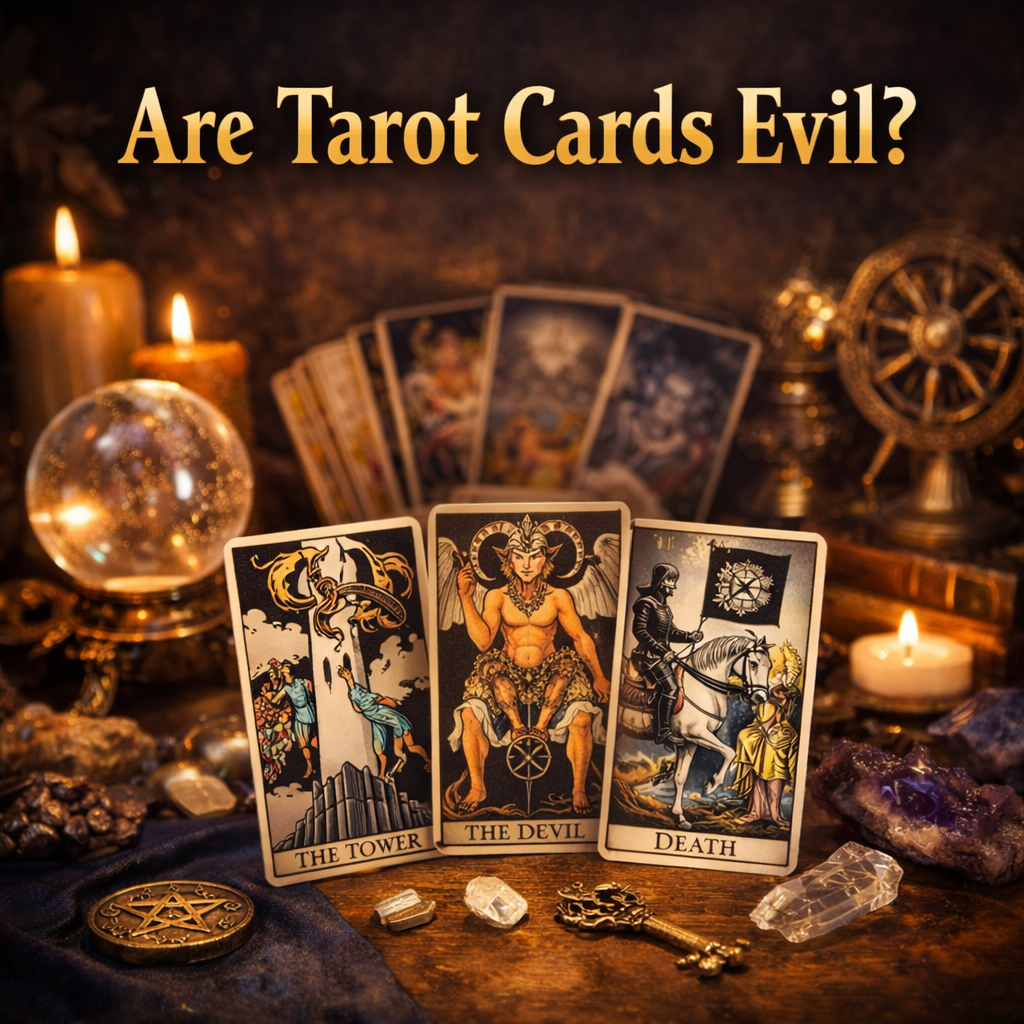
  • Death represents transformation, not physical death
  • The Devil symbolizes attachment or unhealthy patterns
  • The Tower reflects sudden change or truth

These images are often mistaken for something dark, but in reality, they represent psychological and emotional processes that everyone experiences.

Tarot Cards and Religion

Many religious traditions discourage tarot cards because they fall under the category of divination. This does not automatically mean tarot cards are evil; rather, it reflects specific belief systems.

Religious Perspectives on Tarot

PerspectiveView on Tarot
ChristianityOften discouraged as divination
IslamGenerally prohibited as fortune-telling
JudaismMixed views, depends on interpretation
Secular viewSeen as symbolic or psychological

It is important to understand that religious disapproval does not equal inherent evil. Tarot cards themselves do not act independently or possess power.

Do Tarot Cards Have Power?

Tarot cards do not have power on their own. They are pieces of paper with images. Any meaning comes from:

  • Interpretation
  • Human psychology
  • Personal belief

Tarot works similarly to other reflective tools such as journaling, meditation, or therapy prompts. The cards help people think differently, not access supernatural forces.

Tarot as a Psychological Tool

Many modern tarot readers and psychologists view tarot as a mirror of the subconscious mind. Tarot cards encourage reflection, storytelling, and emotional awareness.

Psychological Uses of Tarot

UseDescription
Self-reflectionUnderstanding emotions
Decision-makingExploring options
Personal growthIdentifying patterns
MindfulnessSlowing down thoughts

From this perspective, tarot cards are not evil — they are neutral tools.

Why Some Tarot Cards Look Scary

Some tarot imagery includes skeletons, demons, or dramatic scenes. These images are symbolic, not literal.

For example:

  • Skeletons symbolize endings and renewal
  • Darkness represents the unknown
  • Chaos symbolizes necessary change

Human cultures have always used strong imagery to express transformation. Tarot follows this tradition.

Can Tarot Cards Be Used in a Harmful Way?

Like any tool, tarot can be misused — but misuse does not make the tool evil.

Harmful use may include:

  • Fear-based readings
  • Manipulation or control
  • Encouraging dependency
  • Making absolute predictions

Ethical tarot readers actively avoid these practices.

Ethical Tarot Reading

Responsible tarot reading focuses on empowerment and free will.

Ethical Principles

PrincipleMeaning
Free willYou control your choices
No fearNo threats or curses
HonestyClear, realistic interpretation
RespectEmotional boundaries

Ethical tarot reading is about clarity, not control.

Tarot in Modern Society

Today, tarot is widely used for:

  • Personal development
  • Creative inspiration
  • Coaching and counseling
  • Online content and education

Millions of people use tarot without experiencing harm or fear. Tarot online platforms often emphasize mindfulness and emotional well-being rather than mysticism.

Are Tarot Cards Evil? A Clear Answer

Tarot cards are not evil.
They are neutral objects that reflect symbolism and human experience. Any fear surrounding tarot usually comes from misunderstanding, cultural narratives, or misuse.

What matters is:

  • How tarot is used
  • The intention behind it
  • The emotional responsibility of the reader

Tarot does not remove free will, summon darkness, or control destiny.

Conclusion

The belief that tarot cards are evil is rooted in myth, not fact. Tarot cards have no inherent power and no moral alignment. They are symbolic tools that can be used for reflection, creativity, and personal growth.

Like books, art, or language, tarot reflects the human mind. It can be used responsibly or irresponsibly — but it is not evil by nature.

Understanding tarot requires context, education, and openness rather than fear.

tarot cards meaning

Tarot Cards Meanings

Tarot cards meanings form the foundation of tarot reading. Every tarot card carries a symbolic message that reflects human experiences, emotions, challenges, and transformations. Understanding tarot cards meanings is not about memorizing rigid definitions but learning how symbols, archetypes, and context work together to create insight.

This guide explores the meanings of tarot cards in detail, explaining how the Major Arcana and Minor Arcana function, how interpretations shift depending on context, and how tarot readers work with symbolism in practice.

What Do Tarot Cards Mean?

At their core, tarot cards represent universal patterns of human life. Each card reflects an energy, situation, or inner state that people encounter at different moments. Tarot cards meanings operate on several levels at once:

  • Psychological (thoughts, emotions, motivations)
  • Practical (events, choices, external circumstances)
  • Symbolic (archetypes, cycles, transformation)

Rather than predicting fixed outcomes, tarot cards reveal tendencies and influences surrounding a situation. Their meanings change depending on the question asked, the position in a spread, and the surrounding cards.

The Structure of Tarot Cards

A traditional tarot deck contains 78 cards, divided into two main groups: the Major Arcana and the Minor Arcana. Understanding this structure is essential for interpreting tarot cards meanings accurately.

Tarot SectionNumber of CardsFocus
Major Arcana22Life lessons, major transitions
Minor Arcana56Daily experiences, situations
Total78Complete symbolic system

Major Arcana Meanings

The Major Arcana represents powerful archetypes and significant turning points. When these cards appear in a tarot reading, they usually indicate moments of deep change, realization, or spiritual growth.

Key Themes of the Major Arcana

  • Personal evolution
  • Inner awakening
  • Challenges that shape identity
  • Life-changing decisions

Below are examples of important Major Arcana tarot cards meanings:

CardCore Meaning
The FoolNew beginnings, trust, openness
The MagicianManifestation, skill, intention
The High PriestessIntuition, inner wisdom
The EmpressCreation, nurturing, abundance
The EmperorStructure, authority, stability
DeathEndings, transformation, rebirth
The TowerSudden change, truth revealed
The WorldCompletion, fulfillment

Major Arcana cards often reflect what must be understood or integrated, rather than what can be avoided.

Minor Arcana Meanings

The Minor Arcana focuses on everyday life. These tarot cards meanings relate to emotions, actions, relationships, work, and communication. They provide practical context and details within a tarot reading.

The Minor Arcana is divided into four suits, each associated with an element and life area.

Minor Arcana Suits and Meanings

SuitElementRepresents
CupsWaterEmotions, love, intuition
SwordsAirThoughts, conflict, communication
PentaclesEarthMoney, career, stability
WandsFireAction, creativity, passion

Each suit includes:

  • Number cards (Ace–Ten) — situations and developments
  • Court cards (Page, Knight, Queen, King) — people, personalities, or stages of maturity

Number Meanings in Tarot Cards

Numbers play an important role in tarot cards meanings, especially in the Minor Arcana.

NumberSymbolic Meaning
AceBeginnings, potential
TwoBalance, choice
ThreeGrowth, collaboration
FourStability, structure
FiveConflict, disruption
SixHarmony, resolution
SevenReflection, challenge
EightMovement, effort
NineCompletion, insight
TenEndings, transition

Understanding numbers helps tarot readers interpret patterns across different suits.

Court Cards Meanings

Court cards often confuse beginners, but they are essential to tarot cards meanings. They can represent people, personality traits, or approaches to situations.

Court CardGeneral Meaning
PageLearning, curiosity, messages
KnightAction, movement, pursuit
QueenEmotional or mental mastery
KingAuthority, responsibility

The suit of the court card adds emotional, mental, material, or creative context.

Upright and Reversed Tarot Cards Meanings

Some tarot readers interpret reversed cards, while others do not. When used, reversals add nuance rather than negativity.

Upright MeaningReversed Meaning
Clear expressionBlocked or internalized energy
External situationInner process
Active influenceDelayed or resisted influence

Reversals can indicate imbalance, resistance, or lessons not yet integrated.

How Tarot Cards Meanings Change in Context

Tarot cards meanings are never static. A card’s interpretation depends on:

  • The question asked
  • The position in the spread
  • Nearby cards
  • The reader’s intuition

For example, The Lovers may indicate romance in a love reading, but values and choices in a career reading. The Tower may represent chaos in one context and liberation in another.

Tarot works through relationship and narrative, not isolated meanings.

Tarot Cards Meanings for Self-Reflection

Many people use tarot cards as tools for personal growth rather than prediction. In this context, tarot cards meanings encourage awareness and responsibility.

Common reflective questions include:

  • What energy surrounds this situation?
  • What lesson am I being asked to learn?
  • What choice aligns with my values?

Tarot cards act as mirrors, helping people see patterns they may overlook.

Common Misconceptions About Tarot Cards Meanings

MythReality
Tarot predicts fateTarot explores possibilities
Cards are “good” or “bad”All cards offer insight
Meanings are fixedContext always matters
Tarot is supernaturalTarot is symbolic

Understanding tarot as a symbolic system removes fear and empowers interpretation.

Conclusion

Tarot cards meanings form a rich symbolic language that reflects the complexity of human life. By understanding the structure of tarot, the roles of the Major and Minor Arcana, and the importance of context, tarot becomes a powerful tool for insight rather than prediction.

Whether used for tarot reading, self-reflection, or personal growth, tarot cards offer guidance through awareness, choice, and understanding. Their meanings are not fixed answers but invitations to explore deeper truths within ourselves.