Are Tarot Cards Evil?
The question “Are tarot cards evil?” has been asked for centuries. Tarot cards are often misunderstood and surrounded by fear, religious concerns, and cultural myths. For some people, tarot is seen as a spiritual tool for self-reflection, while for others it raises worries about superstition, dark forces, or moral danger.
To answer this question honestly, it is important to separate myths from facts, understand the history of tarot, and explore how tarot cards are actually used today.
Where Does the Idea That Tarot Cards Are Evil Come From?
The belief that tarot cards are evil does not originate from tarot itself. Instead, it comes from a mix of religious interpretations, historical misunderstandings, and popular culture.
Key Sources of This Belief
- Religious teachings that discourage divination
- Fear of the unknown or symbolic systems
- Association of tarot with occult practices
- Movies and media portraying tarot as dangerous
In many cases, tarot cards became labeled as “evil” simply because they were misunderstood.
The Historical Origins of Tarot Cards
Tarot cards were originally created in Europe during the 15th century as playing cards, not spiritual tools. They were used for games and social entertainment among the nobility.
Only centuries later did tarot begin to be associated with mysticism and symbolism. Even then, tarot was never intended as a method to summon spirits or dark forces.
Tarot History Overview
| Period | Use of Tarot |
|---|---|
| 15th century | Playing cards |
| 18th century | Symbolic and philosophical study |
| 19th–20th century | Spiritual and psychological exploration |
| Modern era | Self-reflection and guidance |
Nothing in the historical development of tarot suggests that tarot cards were created for evil purposes.
What Tarot Cards Actually Represent
Tarot cards are a symbolic language. Each card represents human experiences such as change, growth, fear, love, conflict, and hope.
For example:
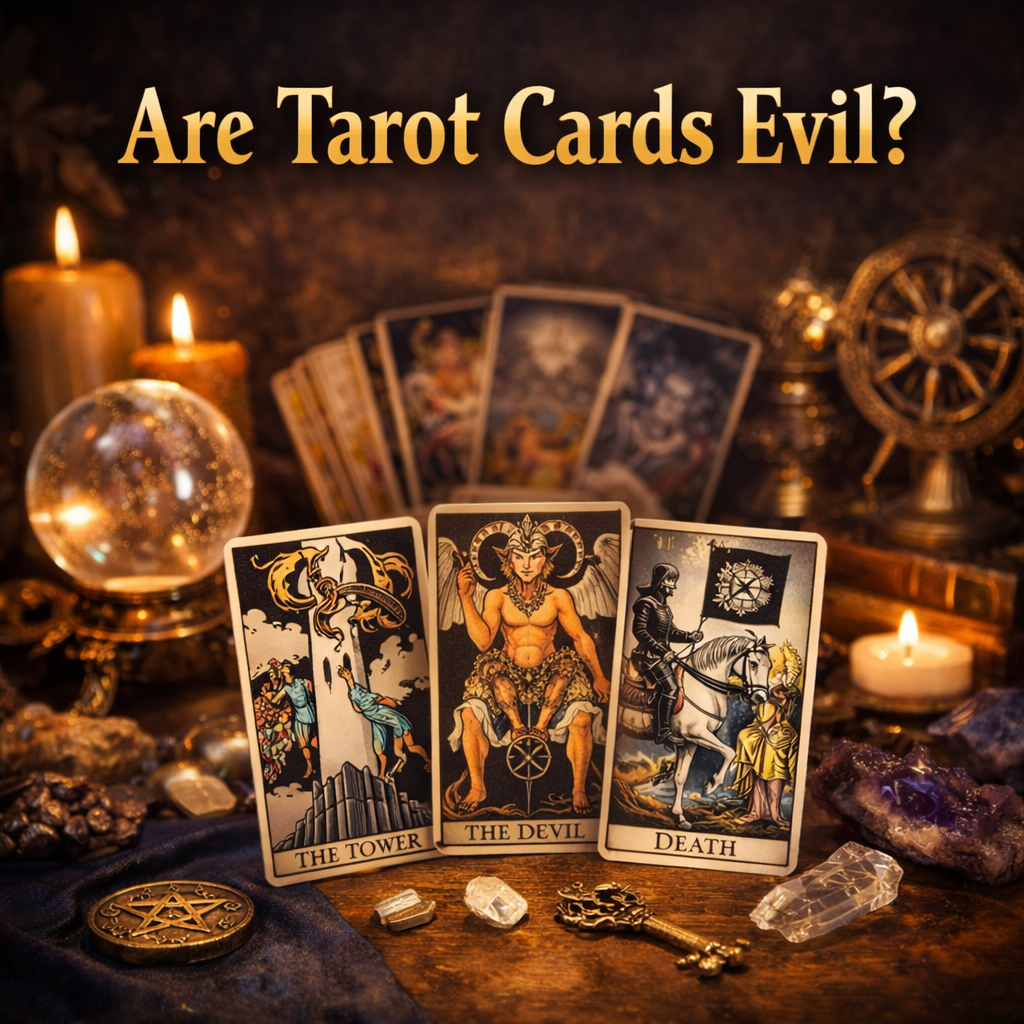
- Death represents transformation, not physical death
- The Devil symbolizes attachment or unhealthy patterns
- The Tower reflects sudden change or truth
These images are often mistaken for something dark, but in reality, they represent psychological and emotional processes that everyone experiences.
Tarot Cards and Religion
Many religious traditions discourage tarot cards because they fall under the category of divination. This does not automatically mean tarot cards are evil; rather, it reflects specific belief systems.
Religious Perspectives on Tarot
| Perspective | View on Tarot |
|---|---|
| Christianity | Often discouraged as divination |
| Islam | Generally prohibited as fortune-telling |
| Judaism | Mixed views, depends on interpretation |
| Secular view | Seen as symbolic or psychological |
It is important to understand that religious disapproval does not equal inherent evil. Tarot cards themselves do not act independently or possess power.
Do Tarot Cards Have Power?
Tarot cards do not have power on their own. They are pieces of paper with images. Any meaning comes from:
- Interpretation
- Human psychology
- Personal belief
Tarot works similarly to other reflective tools such as journaling, meditation, or therapy prompts. The cards help people think differently, not access supernatural forces.
Tarot as a Psychological Tool
Many modern tarot readers and psychologists view tarot as a mirror of the subconscious mind. Tarot cards encourage reflection, storytelling, and emotional awareness.
Psychological Uses of Tarot
| Use | Description |
|---|---|
| Self-reflection | Understanding emotions |
| Decision-making | Exploring options |
| Personal growth | Identifying patterns |
| Mindfulness | Slowing down thoughts |
From this perspective, tarot cards are not evil — they are neutral tools.
Why Some Tarot Cards Look Scary
Some tarot imagery includes skeletons, demons, or dramatic scenes. These images are symbolic, not literal.
For example:
- Skeletons symbolize endings and renewal
- Darkness represents the unknown
- Chaos symbolizes necessary change
Human cultures have always used strong imagery to express transformation. Tarot follows this tradition.
Can Tarot Cards Be Used in a Harmful Way?
Like any tool, tarot can be misused — but misuse does not make the tool evil.
Harmful use may include:
- Fear-based readings
- Manipulation or control
- Encouraging dependency
- Making absolute predictions
Ethical tarot readers actively avoid these practices.
Ethical Tarot Reading
Responsible tarot reading focuses on empowerment and free will.
Ethical Principles
| Principle | Meaning |
|---|---|
| Free will | You control your choices |
| No fear | No threats or curses |
| Honesty | Clear, realistic interpretation |
| Respect | Emotional boundaries |
Ethical tarot reading is about clarity, not control.
Tarot in Modern Society
Today, tarot is widely used for:
- Personal development
- Creative inspiration
- Coaching and counseling
- Online content and education
Millions of people use tarot without experiencing harm or fear. Tarot online platforms often emphasize mindfulness and emotional well-being rather than mysticism.
Are Tarot Cards Evil? A Clear Answer
Tarot cards are not evil.
They are neutral objects that reflect symbolism and human experience. Any fear surrounding tarot usually comes from misunderstanding, cultural narratives, or misuse.
What matters is:
- How tarot is used
- The intention behind it
- The emotional responsibility of the reader
Tarot does not remove free will, summon darkness, or control destiny.
Conclusion
The belief that tarot cards are evil is rooted in myth, not fact. Tarot cards have no inherent power and no moral alignment. They are symbolic tools that can be used for reflection, creativity, and personal growth.
Like books, art, or language, tarot reflects the human mind. It can be used responsibly or irresponsibly — but it is not evil by nature.
Understanding tarot requires context, education, and openness rather than fear.
Leave a Reply